

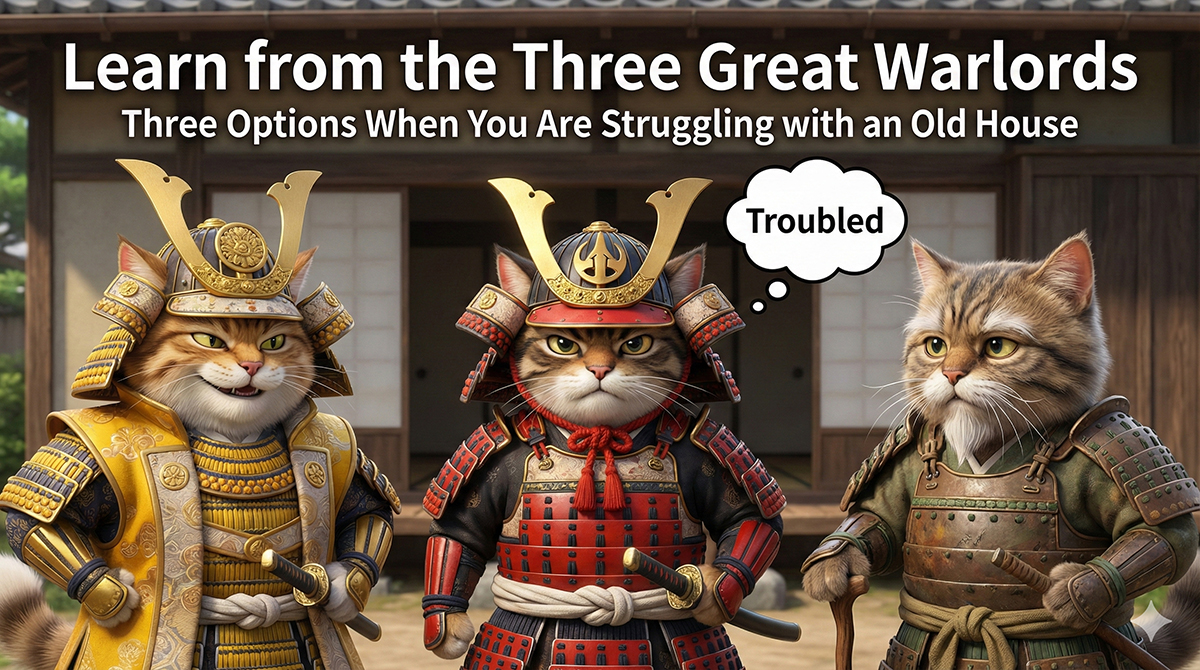
Learn from the Three Great Warlords
Three Options When You Are Struggling with an Old House**
Oda Nobunaga, Toyotomi Hideyoshi, and Tokugawa Ieyasu.
These three warlords survived the turbulent Sengoku era and are often called the Three Great Heroes of Japan.
There is a famous set of sayings that reflects each of their personalities:
Oda Nobunaga: “If the cuckoo will not sing, kill it.”
Toyotomi Hideyoshi: “If the cuckoo will not sing, make it sing.”
Tokugawa Ieyasu: “If the cuckoo will not sing, wait until it does.”
Surprisingly, these three styles perfectly match the choices you face when dealing with an old house.
The Nobunaga Style
Break old values and redesign your life and home.
If your old house is causing serious problems, the Nobunaga approach is to rebuild from scratch.
Structural concerns, poor earthquake resistance, and a layout that no longer fits your modern lifestyle can push you to the limit.
If it troubles you, rebuild it. Your old house can start again.
This means demolishing the existing structure and creating a new one from zero. A custom-built home requires budget and determination, but at Inoue Komuten, we propose designs that maximize the potential of your land. It is an investment in your future and a path to a brand-new life.
This is a bold choice worthy of Nobunaga’s innovative spirit.
The Hideyoshi Style
Use ingenuity to rearrange your home for your life.
Maybe the house isn’t “bad” enough to demolish, but it is inconvenient. Until now, you may have adjusted your life to fit the house. From here on, you can adjust the house to fit you.
If it troubles you, change it. Your old house can evolve.
Widening pathways for caregiving, removing steps, repurposing unused rooms, or modernizing the flow. This flexible, clever approach is exactly what Hideyoshi—known for his resourcefulness—would choose. This is also one of Inoue Komuten’s greatest strengths.
Improving daily life through thoughtful modifications is the essence of “making it sing.”
The Ieyasu Style
Cherish what you have and preserve it for the long term.
If your budget is limited, or if you deeply love the history of the building, you can choose to make only essential repairs and continue living there. Fix leaks, reinforce dangerous areas, and rely on wisdom to maintain the rest.
If it troubles you, be patient. Your old house can endure.
Living in a familiar home without letting it go, sharing your life with it slowly and steadily. This is the Ieyasu approach. Inoue Komuten can propose the minimum necessary repairs from a practical, expert perspective.
This is a patient choice that reflects the wisdom of “waiting until it sings.”
Conclusion – It’s Not About the “Correct” Answer, But the Answer You Can Accept.
Nobunaga, Hideyoshi, and Ieyasu each represent a different path:
- Rebuild (Transformation)
- Change the layout (Adaptation)
- Continue living as is (Preservation)
There is no wrong choice. What matters is what you value, how you want to live, what you want to keep, and what you are ready to let go.
So, which type are you?
- The Nobunaga type: Ready for a bold redesign.
- The Hideyoshi type: Improving life with clever adjustments.
- The Ieyasu type: Preserving what you have and living with it carefully.
Inoue Komuten has deep on-site experience and understands Japanese houses inside and out. That is why we can flexibly support any of these three paths.
As long as people live in it, a house is alive. And every living house eventually poses a question: Should I keep living here? Should I rebuild? Or should I change the layout?
The answer shouldn’t be about correctness. It should be about your own conviction.
We are here to help you find that answer.
by Inoue Koumuten
Which type are you? Consult us about choosing between the Nobunaga, Hideyoshi, and Ieyasu styles.
Contact Information
We may be on-site and unable to answer immediately. And also, to avoid any misunderstandings or miscommunication, please contact us first via LINE or email. This helps us keep a clear record and respond accurately.
LINE / Email: Reach us anytime – we’ll reply as soon as we’re off-site.
LINE

Click the button on the left and add INOUE KOUMUTEN as a friend before sending your inquiry.
We’ve prepared two forms to better match your situation. Choose the path that suits your home journey, whether you already own a property or are planning to build.