
The “Heart” Learned from the Elderly, and the Origin of End-of-Life Support
Suddenly, I must confess: I failed once in marriage.
In my first marriage, my partner’s workplace went bankrupt even before our wedding, and he stopped working afterward. I lived by drawing down the savings I had accumulated during my single years, but even after our child was born, nothing changed. I divorced early.
When my child was only one year old, I placed him in daycare and worked desperately to survive as a pair of mother and child. One day, he caught chickenpox, and I had no choice but to take time off work to nurse him.
The peak had passed, and it seemed only a matter of time until recovery.
But then I myself developed chickenpox. In adulthood, the illness is severe. My body was covered head to toe with blisters, and I burned with a fever of 42 degrees Celsius, barely able to stand.
At that time, I was estranged from my family and had no option of relying on them.
My grandparents could have helped, but I did not want to worry them.
I thought: I must lower this fever, or it will be truly dangerous. Somehow, I must walk one kilometer to the nearest clinic. But I could not leave my one-year-old child alone at home.
Carrying him, I sat down to rest many times along the way, but finally reached the clinic.
After receiving the doctor’s examination and medicine, I summoned my strength again to walk back home.
At that clinic was an elderly man who lived in the same apartment building. I knew his face but had never spoken to him.
It was a small clinic, so perhaps he overheard me telling the doctor and staff, “I have no family to rely on, so I must manage on my own.”
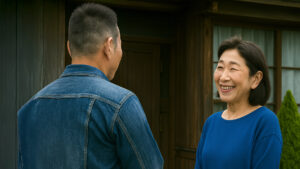
Soon after I returned home, that elderly man came with his wife.
The wife said:
“My husband said, ‘Those children are pitiful. That boy is pitiful. In that condition she cannot care for him. Go buy something the boy can eat. Poor thing.’ So I bought these. Please feed them to your boy.”
She handed me a bag with bananas, mandarins, and sweet bread.
I did not know how to thank them. “Thank you” was not enough.
After I recovered, I visited their home with a gift to express my gratitude.
Many people may think “poor thing” but do nothing. Yet this couple helped us. In this harsh modern world, such people still exist.
I deeply appreciated them. For their generation, helping neighbors in need was simply natural.
No matter how convenient the world becomes,
The “heart” learned from the elderly must never be lost or hidden. It must be lived and passed on.
This was the vow I made.
Reforming Society vs. Reforming Daily Life: My Form of Politics
Politics and our daily lives often feel distant. Some think politics is only for a few, unrelated to ordinary citizens.
But I began to wonder: are not social problems always influenced by politics?
Like ripples spreading when a stone is dropped into a pond, the effects reach ordinary citizens.
I wanted to understand the mechanism of those ripples, which is politics.
As a single mother and passionate youth, I entered a political training school.
There, lectures, workshops, and camps were held with distinguished speakers from many fields. We learned campaign headquarters management, street speeches, and election cars. It was truly a “school for aspiring politicians.”
When a student ran for office, fellow students rushed to support.
These experiences remain treasures for me.
But sadly, I saw many candidates who, before election, burned with “true reform for the sake of society,” yet after winning and serving two terms, changed completely.
It is not that they were bad people. Rather, no matter how hard they tried, they could not move the great currents.
The ripples were not mere pond waves but whirlpools of the Naruto Strait.
For a new politician and supporters to reverse such whirlpools was nearly impossible.
Gradually, some lost spirit, shifting from “fighting to realize ideals” to “scheming to keep their seat.”
Realizing this, I did not become indifferent to politics, but I changed my view.
Instead of aiming to be a politician to change the flow, I decided to use my wisdom so that I and those around me could survive this modern age.
Like the elderly couple who once helped my child and me, I resolved to be someone who does not look away. For the elderly, I would do what I could, becoming their eyes, ears, and hands.
It may be small, but this is my politics.
Learning from Hagakure: End-of-Life as Life’s Arrangement
In today’s age of nuclear families and extreme low birthrate, issues of caregiving, funerals, and graves concern everyone.
Caregiving may come at any time. Life’s end may come at any time.
Hagakure says, “Bushido is found in death.” This does not mean simply “a samurai must die.”
Even if one acts with death in mind, life and death are beyond human control.
If one flees for self-preservation, one may survive but be a coward.
If one dies due to mistaken judgment but does not flee, it is not shameful.
This is enough as a mindset of Bushido.
Therefore, be prepared at all times.
If you are always ready for death, you are freed from the bondage of self-preservation, and can fulfill what you must do.
This is the philosophy I find in Hagakure.
Just as we breathe without thinking “I must breathe to live,” all living beings have the instinct to live.
When we hear “death,” we instinctively feel fear. But death comes to all life without exception.
No one knows when.
Therefore, live your life fully, without regret, until the end.
End-of-Life Support at Inoue Komuten
One reason I chose to remarry the second son and master carpenter of Inoue Komuten was his kindness toward the elderly.
After moving to Joyo upon remarriage, I, as the “Okami of Miscellaneous Tasks,” became deeply involved with clients, helping in many ways.
As a member of Inoue Komuten, I have accompanied many clients until their final moments.
The company’s principle of “supporting a house from beginning to end” is rooted in facing each client’s wish of “how do I want to live in this house” as our own matter.
From the day a house is built, it ages together with its owner. We stand between the house and the client, supporting quietly from the wings until the end. This is the way we value.
You Are the Protagonist, Inoue Komuten Is the Stagehand
End-of-life planning is not dark, lonely, sad, or painful. It is intellectual, filled with kindness for those left behind, and, I believe, supremely cool.
- Not wanting to burden surviving family
- Wishing to be remembered with good memories
- Wanting to be called “dignified until the end”
- Leaving advice or messages for future generations
Each person has different wishes. End-of-life planning is about living out your own story, performing the final grand stage of life as a positive life work.
If you do not know where to begin, please consult us about anything.
Returning the kindness received from society back to society. That is the “small politics” I can do through end-of-life support.
Inoue Komuten, Okami of Miscellaneous Tasks
Designing the final chapter of your life as a stage
Contact Information
We may be on-site and unable to answer immediately. And also, to avoid any misunderstandings or miscommunication, please contact us first via LINE or email. This helps us keep a clear record and respond accurately.
LINE / Email: Reach us anytime – we’ll reply as soon as we’re off-site.
LINE

Click the button on the left and add INOUE KOUMUTEN as a friend before sending your inquiry.
We’ve prepared two forms to better match your situation. Choose the path that suits your home journey, whether you already own a property or are planning to build.